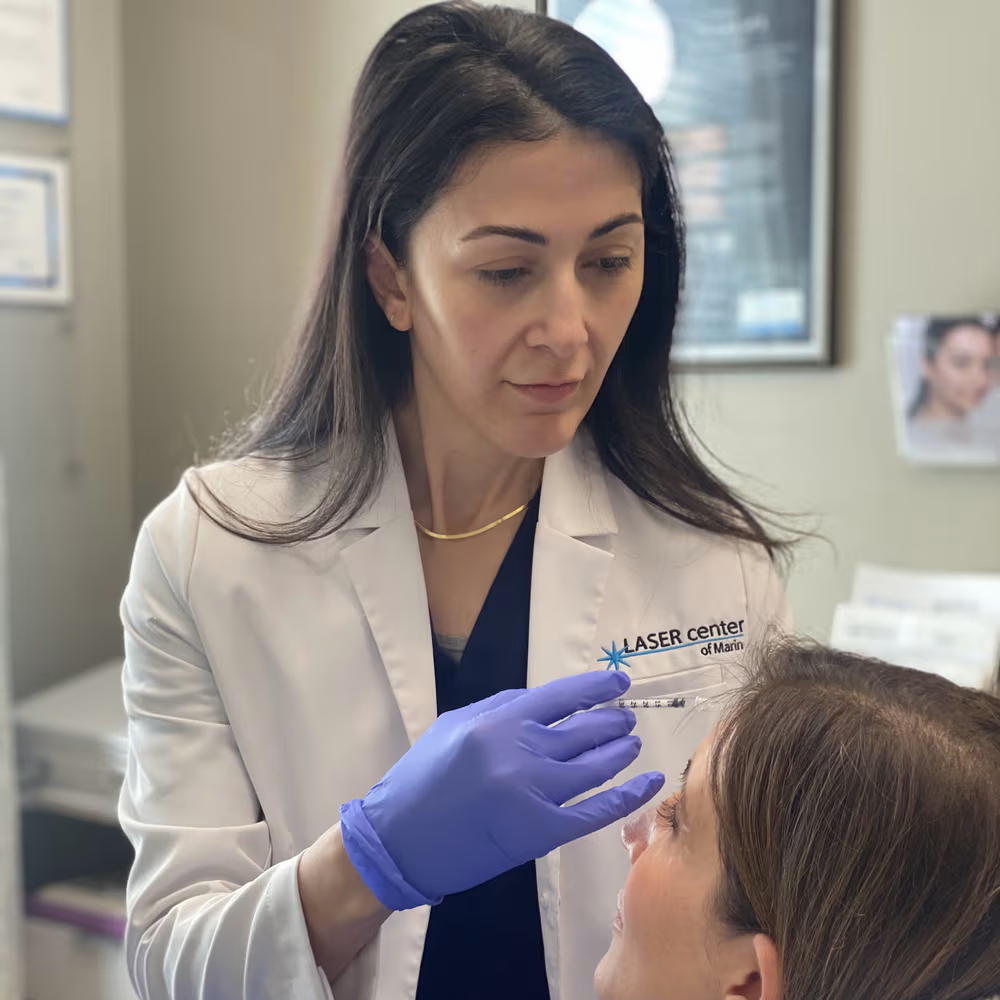
Botox for crow's feet is a physician-supervised injectable treatment that temporarily relaxes the muscle responsible for the fine lines that fan out from the outer corner of the eye. The same approach applies to forehead lines, which form from a different muscle but the same repeated-contraction pattern.
Both concerns tend to stand out more by early fall, after a summer of squinting into bright sun without enough shade or sunglasses.
Squinting deepens crow's feet and forehead lines because it forces the same facial muscles to contract repeatedly, and skin that creases in the same place thousands of times a season starts to hold that crease at rest. Sun glare is a common trigger.
Narrowing the eyes against bright light, wind, or salt air recruits the same muscle groups every time, and a Marin County summer of outdoor time gives that pattern months to repeat.
Crow's feet come from repeated contraction of the orbicularis oculi, the ring-shaped muscle that circles each eye and closes the eyelid. Squinting against the sun or wind tightens this muscle at the outer corner, and the fine, fanning lines that result are a direct byproduct of how often that motion repeats.
The frontalis is the muscle that raises the eyebrows and furrows the forehead, and forehead lines form where its repeated contraction creases the skin above the brow. Squinting against the overhead sun tends to pull the brows up at the same moment it narrows the eyes, so both muscles can be engaged at once during a summer of glare. That overlap is one reason forehead lines and crow's feet frequently show up in the same patient at the same time.
Botox works by blocking the nerve signal that tells a muscle to contract, not by filling or resurfacing the skin. The active ingredient, onabotulinumtoxinA, binds to receptors on the motor nerve terminal and blocks the release of acetylcholine, the neurotransmitter that signals the muscle to contract, which stops the muscle from firing at its usual strength.
At Laser Center of Marin, Botox is administered as part of a physician-supervised practice, and the clinic holds an Allergan Black Diamond provider designation, reflecting a high volume of experience with Botox and Juvederm. Because the orbicularis oculi and frontalis sit close to the eye and eyebrow, precise placement and dosing matter more here than in areas with less delicate movement.
With the targeted muscle temporarily unable to contract at full strength, the skin above it stops creasing with every squint or brow raise, allowing the existing line to soften over the following days.
The same muscle-relaxing approach is used elsewhere on the face for different goals, including the orbicularis oris around the mouth. Relaxing that muscle slightly is the basis of the lip flip technique offered at Laser Center of Marin.
The FDA-approved label for BOTOX Cosmetic lists both concerns by name and by the muscle involved. It covers "moderate to severe lateral canthal lines associated with orbicularis oculi activity" and "moderate to severe forehead lines associated with frontalis muscle activity," both described as a temporary improvement in appearance for adult patients.
The full prescribing label, maintained by the National Institutes of Health's DailyMed database, also describes how the effect develops for glabellar lines specifically: chemical denervation of the injected muscle begins one to two days after injection and increases in intensity through the first week. The label does not make an equivalent timing statement for lateral canthal or forehead lines.
The label does not state a specific duration figure for the crow's feet or forehead lines indications, so a provider can advise on retreatment timing based on the individual patient's response.
Expect a short in-office injection appointment with no downtime, followed by a gradual softening of the treated lines rather than an immediate change. Results build in over the days following treatment and typically settle within about two weeks, consistent with how Botox behaves elsewhere on the face.
Patients should tell their provider before treatment about pregnancy or nursing status, any neuromuscular condition, a known allergy to any botulinum toxin product, or a past reaction to a neuromodulator.
Possible effects include bruising, temporary muscle weakness, eyelid heaviness, or asymmetry while the treatment is settling. Patients should seek medical attention for difficulty breathing, difficulty swallowing, or vision changes after treatment.
Fall is a practical time to treat crow's feet and forehead lines because the two-week settling window fits comfortably before the run of holiday gatherings and photos that starts in November. Scheduling in September or October also means less risk of an outdoor event landing during the early bruising or swelling window that can follow injection.
Treating in fall rather than waiting until December also allows time to reassess results and adjust before the season's more demanding photo occasions, instead of booking a first treatment days before an event with no buffer to see how the patient responds.
The mechanism is the same: temporarily relaxing the muscle so it stops repeatedly creasing the skin, but the two areas involve different muscles (orbicularis oculi for crow's feet, frontalis for forehead lines) and are dosed separately based on each muscle's strength and the patient's anatomy.
Botox is dosed to relax the targeted muscle's ability to crease the skin, not to stop movement altogether. A provider adjusts placement and dose so a patient can still squint, raise their brows, and show expression while the treated lines soften.
Because the full effect takes about two weeks to appear, patients typically schedule a few weeks ahead of a specific event rather than the week before. That buffer leaves room for the treatment to finish developing and for a touch-up if one is needed.
Laser Center of Marin builds a personalized treatment plan around each patient's anatomy and how the orbicularis oculi and frontalis move on their face, rather than dosing every patient the same way. The clinic offers physician-supervised Botox in Corte Madera for Marin County and Bay Area patients.
Call (415) 945-9875 or schedule online at marinlaser.com/contact.


