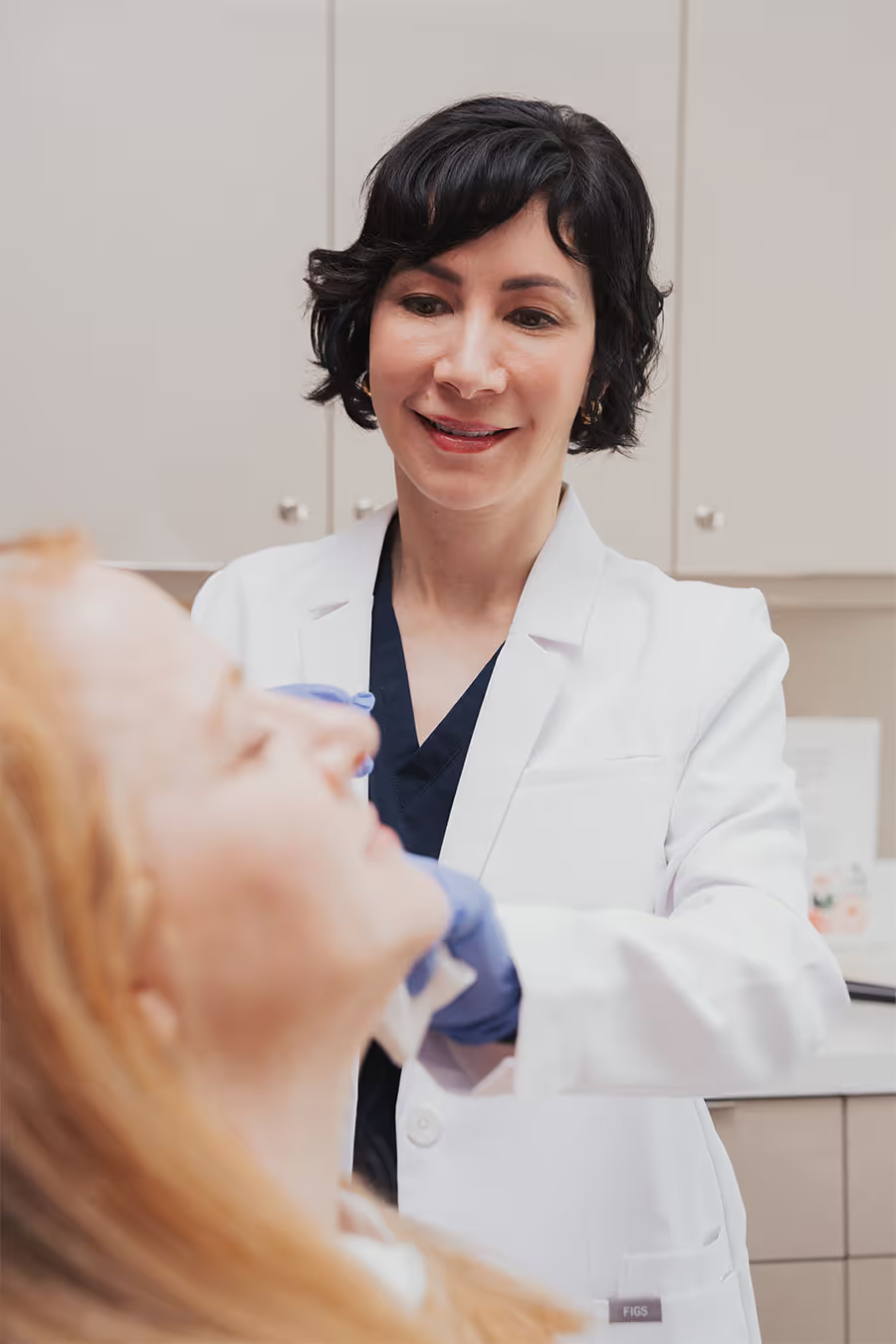
Botox and Dysport are the two most widely used wrinkle-relaxing injections in the United States. They share the same active ingredient family, botulinum toxin type A, and they treat the same fundamental concerns: forehead lines, frown lines (the "11s"), and crow's feet. Yet the patient experience can feel meaningfully different depending on which one you choose, the area being treated, and the injector behind the needle.
At Laser Center of Marin, we have been injecting neuromodulators since 2003, and we have consistently been awarded Black Diamond and Platinum Level designations by both Allergan (Botox) and Galderma (Dysport), recognition given only to top injection clinics in the country. Because we are not tied to one manufacturer's incentives, the recommendation we give you is genuinely product-agnostic. This guide explains how we actually choose between the two for our Marin County patients.
| Factor | Botox (Allergan) | Dysport (Galderma) |
|---|---|---|
| Active ingredient | OnabotulinumtoxinA | AbobotulinumtoxinA |
| FDA approval (cosmetic) | 2002 | 2009 |
| Onset of visible results | 1-3 days for most patients | 1-3 days for most patients |
| Full effect | About 2 weeks | About 2 weeks |
| Typical duration | 3-4 months | 3-4 months |
| Diffusion (spread from injection point) | More precise | Slightly wider |
| Unit conversion | 1 Botox unit | ≈ 2.5-3 Dysport units |
| Per-unit price | Higher | Lower |
| Per-treatment cost (typical) | Comparable | Comparable |
| Rewards program | Allergan Allē | Galderma Aspire |
| Best for | Precision work, smaller muscles, masseter | Larger surface areas (forehead), faster onset events |
Both products are extremely safe when administered by a properly trained injector under medical supervision. The differences are real but subtle, and they only matter when matched to the right patient, muscle, and goal.
Both Botox and Dysport are purified forms of botulinum toxin type A. Once injected into a targeted muscle, the toxin temporarily blocks the nerve signal that tells the muscle to contract. Without that signal, the muscle relaxes, and the overlying skin smooths out. New dynamic lines stop forming, and existing lines soften.
The mechanism is identical. What differs is the formulation, which changes how many units you need and how far the effect reaches:
You may read that Dysport spreads more because its molecules are smaller. Research does not support that explanation: lab studies show the protective proteins around both toxins break away within about a minute at body pH. What controls spread is dose, dilution (how much fluid the units are mixed in), and injection technique. That is why the injector matters more than the brand.
Patients often ask which one works faster. The answer is closer than most people expect.
Both reach full effect at about two weeks. If you have an event coming up, book at least two weeks ahead, whichever product you choose.
Duration is essentially the same for both: roughly 3 to 4 months for most patients in most areas. Individual factors that affect duration are far more impactful than which product you chose:
We sometimes hear patients claim Dysport "lasts longer" or Botox "lasts longer." Across our 20+ years of injecting, the population-level data does not bear this out. What matters more is adequate dosing, under-dosed Botox is the most common reason a patient feels their product "wore off too fast."
This is where the conversation often gets confusing.
A Botox unit and a Dysport unit are not equivalent. The standard conversion used by experienced injectors is roughly 1 unit of Botox ≈ 2.5 to 3 units of Dysport. This means a treatment that uses 20 units of Botox in the glabella might use 50-60 units of Dysport for the same clinical effect.
The takeaway: never compare Botox and Dysport on a per-unit price basis. What matters is the per-treatment cost and the per-area cost, not the per-unit cost. Reputable clinics, including ours, price treatments in a way that makes the two products roughly equivalent at the area level.
If a clinic quotes Dysport at a dramatically lower per-unit price without disclosing the conversion, that is a flag.
In Marin County, expect:
At a typical full-face refresh, the total cost is comparable between the two products. Where the value calculus diverges is in rewards programs:
If you already use one ecosystem heavily, for example, you're a long-time Restylane filler patient, Aspire points stack faster, which makes Dysport the more economical neuromodulator for your portfolio. The reverse is true for committed Juvederm patients.
We participate in both programs, so you don't have to choose your ecosystem at the front door.
These are tendencies, not rules. A skilled injector matches the product to the muscle and the patient, not the other way around.
Both products share essentially the same side effect profile:
There is no downtime. Patients return to work, exercise (after 4 hours), and normal life immediately. The main aftercare instructions are universal:
Bruising risk is the same with either product and depends almost entirely on injector technique and your medication/supplement profile (blood thinners, fish oil, vitamin E, alcohol).
Yes, and many of our patients do, though we usually phase it across visits rather than mixing in a single session. A common pattern:
We don't mix the two products within the same syringe. They are formulated differently and that has no clinical benefit. But across separate syringes, in different areas, on the same day, absolutely.
Yes. There is no clinical reason you cannot switch, and many of our patients do, sometimes for cost, sometimes for rewards, sometimes for a faster onset before an event. The two products do not interact, and switching does not "reset" or extend your duration.
If you've been told you "can't switch," it is usually because the clinic only carries one product. Both are excellent. Both have decades of safety data. Choose based on the muscle, the goal, and your timing.
We're one of the largest laser and medical aesthetics clinics in the Bay Area, serving Marin since 2003, and our position has always been that the best clinic is the one with the most tools, not the most allegiance.
That's why we work with both Allergan (Botox, Juvederm, SkinMedica, CoolSculpting) and Galderma (Dysport, Restylane, Sculptra), and have earned top-tier provider status with each. Offering both means:
Whether you choose Botox, Dysport, or a thoughtful combination of both, the protocol, the technique, and the safety standard is the same.
For many patients with broad forehead movement, Dysport's wider diffusion produces a smoother result with fewer injection points. But "better" depends on your anatomy and goal, some patients prefer Botox's precision in the forehead. We evaluate this at the consultation.
You can switch at your next treatment visit (typically 3-4 months later). There is no waiting period required between products.
Bruising is overwhelmingly a function of injector technique, your medication and supplement profile, and individual blood vessel anatomy, not the product. The two have essentially the same bruising rate.
Because a Dysport unit is biologically smaller than a Botox unit. The conversion is roughly 2.5-3 Dysport units to 1 Botox unit. Per-treatment cost is comparable.
Yes. This is common for patients who want Dysport's diffusion in the forehead and Botox's precision around the eyes. We perform combination visits regularly.
"Frozen" results come from over-dosing, not from product choice. With appropriate dosing, which is what trained, experienced injectors do, neither product produces a frozen look. Natural-looking movement preservation is our default philosophy.
If you're deciding between Botox and Dysport, or you've been treated elsewhere and want a second opinion, schedule a consultation with our injection team. We'll evaluate your facial dynamics, discuss your timeline and goals, and recommend the product (or combination) that genuinely fits, with full transparency about cost and rewards.
We've been caring for Marin County and the Bay Area since 2003. Book a consultation or call us at (415) 945-9314.