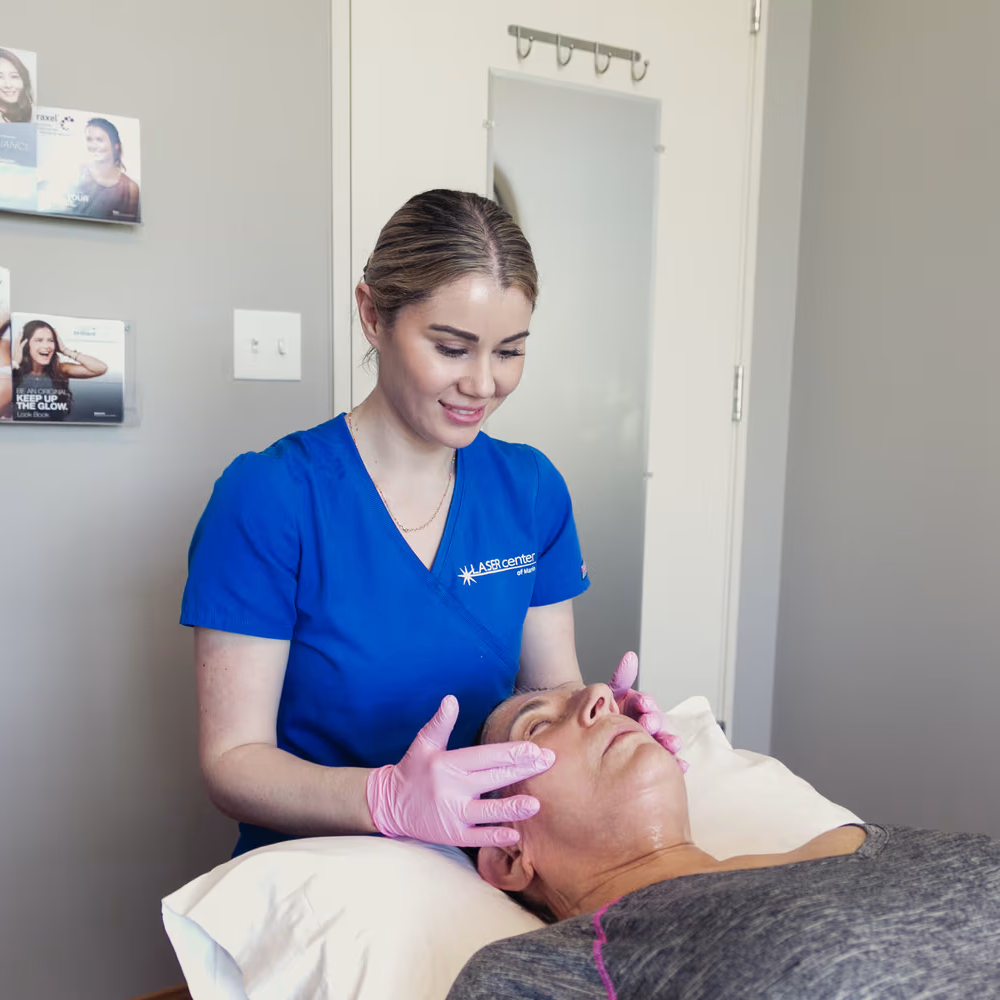
Most patients with reactive skin assume dermaplaning is too aggressive for them. They've been advised to keep their routine gentle, avoid anything too active, and do less rather than more. That instinct is not wrong as a general principle. It just does not apply here. Dermaplaning is not that kind of treatment.
The assumption that the blade must be more aggressive than the acid misunderstands what each treatment actually does. A chemical exfoliant sits on the skin after application and continues reacting until neutralized or fully absorbed. In reactive skin, that carry-over window is where stinging, redness, and barrier disruption typically happen.
A dermaplaning blade removes dead surface cells and then lifts. No active ingredient remains in the tissue after the session ends. For a meaningful number of patients with sensitive skin, this distinction makes dermaplaning the more tolerable option, not the more aggressive one.
The Laser Center of Marin has provided dermaplaning to Marin County patients since 2003. Our providers make individual skin assessments on the day of every appointment. The condition of the skin on that day determines whether the session proceeds, not the booking history.
Dermaplaning uses a sterile, single-use surgical blade held at a 45-degree angle against clean, dry skin. The blade removes the outermost layer of the stratum corneum along with the fine vellus hair present across most of the face. The stratum corneum is the dead-cell surface layer of the epidermis.
The stratum corneum is not living tissue. It is the terminal layer of a continuous renewal cycle. Skin cells produced in the lower epidermis migrate to the surface over approximately 28 days before shedding. Dermaplaning removes these cells several days before they would shed on their own. The blade does not cut into the dermis (the living layer beneath the skin's surface) or any living tissue.
A published study, Dermaplaning for Transdermal Drug Permeation Enhancement: A Qualitative and Quantitative Assessment, confirmed through skin tissue analysis that the blade removes the stratum corneum. The study found a measurable drop in skin electrical resistance following dermaplaning, signifying depletion of the barrier layer. The epidermis below the stratum corneum remains intact.
The session produces two simultaneous changes. The dead-cell layer that diffuses and flattens light reflection is removed, and the vellus hair that makes makeup sit unevenly is cleared. Both changes are visible on the same day.
Chemical exfoliation uses acids or enzymes to dissolve the bonds holding dead cells together. In skin with a healthy barrier, this process is well-tolerated. In reactive skin, the acid continues working after application because it has no endpoint except neutralization or full absorption. That ongoing chemical contact is where irritation accumulates in skin that has a lower tolerance for sustained active ingredient exposure.
Dermaplaning removes the same dead surface cells but asks nothing from the skin's chemical tolerance. There is no acid to buffer, no pH (acidity level) to manage, and nothing active in the tissue after the blade lifts.
For patients who have reacted to glycolic acid, lactic acid, or enzyme peels, dermaplaning often produces the same surface-clearing result. The prolonged redness, tightness, or stinging that those patients know does not follow.
One practical consequence is that barrier-supportive products applied immediately after dermaplaning absorb more effectively into freshly cleared skin. Ceramide serums, niacinamide, and peptide formulas penetrate deeper layers of the stratum corneum on a cleared surface, which amplifies their effect in the post-treatment window.
Sensitive skin as a baseline trait is not a contraindication. Active inflammatory conditions are. The distinction is specific and clinically meaningful.
The modification for sensitive skin is in pressure and pace, not in the tool itself. The same sterile blade is used. What changes is that our esthetician applies only the weight of the blade resting on the surface, with no additional downward pressure from her hand.
This is a passive pressure technique. Dead cells are lifted by the blade's angle and movement rather than by force. The stroke length is shorter, and the pace is more deliberate. The skin is observed in real time throughout the session for any sign of reactivity that would indicate stopping or adjusting.
The day of assessment is non-negotiable, and most sensitive skin patients find it reassuring rather than inconvenient. A prior consultation does not account for a new rosacea flare, a recent medication change, or a reaction to a new skincare product. Our providers evaluate the skin's current condition at the start of every session. The treatment plan follows from that assessment, not from the booking history.
The post-treatment window requires more attention for sensitive skin patients than for patients with resilient skin. The cleared surface improves product absorption, and that same openness increases reactivity to the wrong products.
A ceramide-rich moisturizer applied morning and evening for the first three to five days supports the barrier as it reestablishes following treatment.
For most patients with well-controlled rosacea or eczema, this worry turns out to be bigger than the reality. Dermaplaning performed during full remission, with passive pressure technique and appropriate aftercare, does not typically trigger a flare.
The mechanical nature of the treatment is generally less inflammatory for reactive skin than acid-based exfoliation. If your condition is active or recently active, a consultation before booking is the appropriate first step.
Most sensitive skin patients see mild surface pinkness that resolves within one to two hours. Patients with highly reactive skin may stay slightly flushed for two to four hours. Persistent redness lasting beyond a full day is not an expected outcome with the passive pressure technique and appropriate aftercare.
The standard interval of three to four weeks aligns with the skin's natural renewal cycle. Sensitive skin patients typically benefit from starting at four to six weeks until their individual response is established. Our providers advise the right cadence at the first appointment based on how the skin responds during and after the session.
The right choice depends on the primary concern. DiamondGlow combines exfoliation, extraction, and serum infusion in one pass. It is a strong option for sensitive skin with congestion or dehydration as the main concern. Dermaplaning is often the better fit for sensitive skin where the goal is surface clarity and improved product absorption without any active ingredient involvement. Your provider will discuss both options at your consultation.
Many patients can apply light mineral-based coverage the same day for events. For sensitive skin, waiting until the following morning before applying any foundation is the more conservative and generally recommended approach. Fragrance-free, mineral-based formulas are preferred in the first two days.
Sensitive skin deserves a specific answer, not a general one. The right timing, the right technique, and the right aftercare plan make dermaplaning a genuinely beneficial treatment for reactive skin rather than a risk. The wrong approach to any of these elements is what produces the experiences that have made some sensitive skin patients cautious.
If you have been told dermaplaning is not for you without anyone actually assessing your skin, that is worth revisiting. The Laser Center of Marin has served Marin County as a physician-supervised med spa since 2003. Our full skincare team assesses every patient's skin on the treatment day and builds the session around what they find.
Explore our full treatment menu for more options. Visit us at 770 Tamalpais Drive, Suite 301, Corte Madera, CA 94925, book online, or call (415) 945-9314 to schedule your consultation.
Medical Disclaimer: Consultation required. Individual results may vary based on skin type, current condition, and aftercare compliance. Dermaplaning is contraindicated during active rosacea flares, eczema flares, and overactive acne lesions. A day-of skin assessment is performed before every treatment.