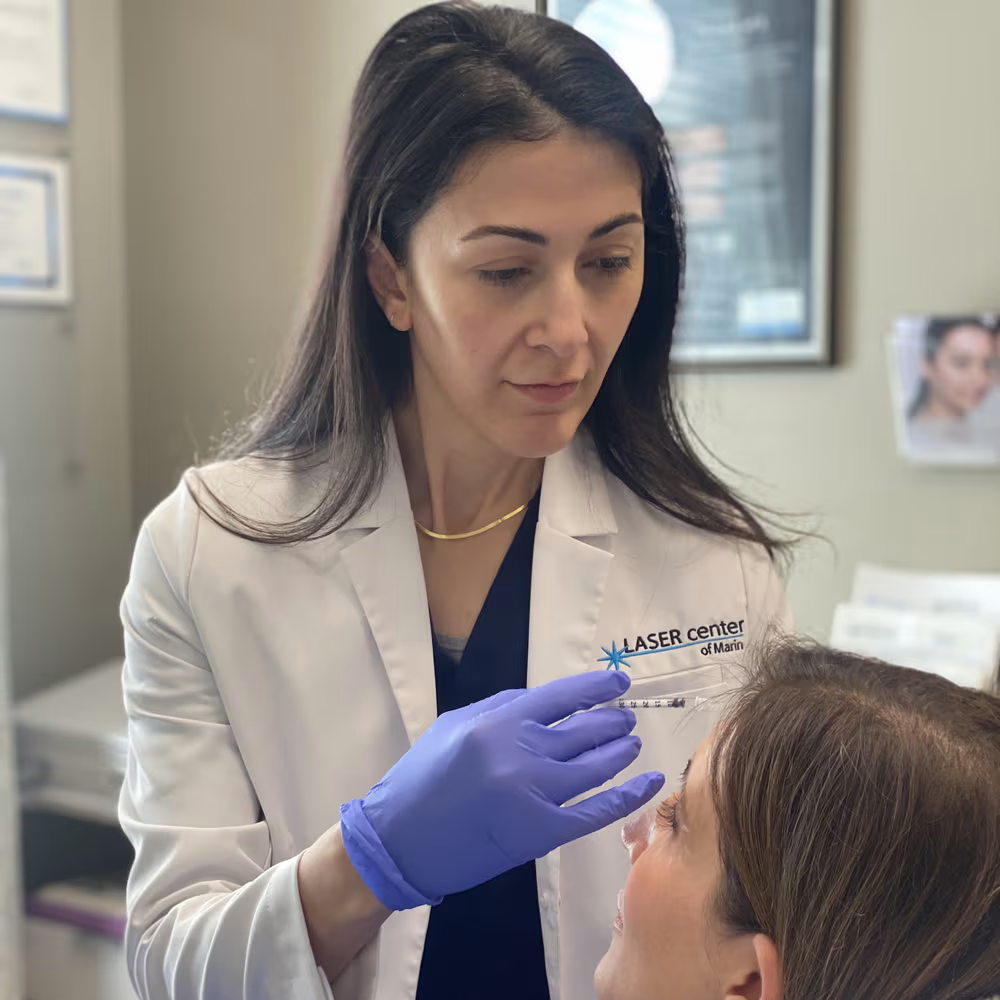
If you've come to this page worried that something went wrong, that instinct makes sense. Most patients who come to us, concerned about migration, believe the filler itself is to blame.
Filler migration is not a property of the material. It is the result of specific decisions: which product, how much, how deep, in which zone, and how recently the same area was treated. Understanding those decisions is how you evaluate an existing result and how you prevent the same outcome at a future appointment.
According to the American Society of Plastic Surgeons, 5,294,603 hyaluronic acid filler procedures were performed by its members in 2023. As the procedure becomes more common, understanding what migration is and how to prevent it matters more than ever.
If you are reading this because something about your current result does not look right, you are in the right place.
Filler migration is the movement of injected hyaluronic acid gel beyond the anatomical boundary where it was placed. The gel does not dissolve or disappear when this happens. It shifts into an adjacent tissue plane, producing visible fullness or firmness that the patient did not intend.
In the lips, filler migration most commonly appears as a soft ridge or shelf above the upper lip border (the vermilion border, the line between the colored lip and surrounding skin). Around the eyes, it can show as persistent puffiness or a subtle bluish tint beneath the skin.
The first thing worth knowing, because it reassures most patients immediately, is the distinction between migration and normal post-treatment swelling. Swelling is a normal tissue response to injection. It peaks within 24 to 48 hours and fully resolves within two weeks.
Migration is structural. It persists past the two-week mark and does not reduce with time the way swelling does. A ridge or unexpected fullness present at the four-week point is not swelling.
The most common cause is a mismatch between product stiffness and the zone where it was placed. Every HA filler has a G-prime value, a measure of how firm or stiff the gel is. Firmer, higher-G-prime products belong in structural zones like the chin and jawline. They are designed to sit against bone with minimal movement forces acting on them.
When a firm product is placed in a high-mobility zone like the lips, constant mechanical activity pushes against material not engineered for that environment. Eating, speaking, and expression all create that force. Over time, the gel shifts.
Superficial placement creates the same problem through a different mechanism. HA gel placed too close to the skin surface sits in a less mechanically stable tissue layer. Deeper tissue layers hold product more reliably because the surrounding tissue provides greater resistance to displacement. Products placed too shallowly lose that structural protection.
Cumulative overfill is the third major contributor. Each session adds to the total volume a zone is holding. When that volume exceeds what the anatomy can maintain in place, pressure is distributed outward along the path of least resistance.
The lips are especially susceptible because the tissue volume of the lip body is limited, and the vermilion border creates a visible boundary. Once a product crosses that border, migration becomes apparent.
Three areas account for the majority of migration cases we evaluate at our Corte Madera clinic:
The signs that indicate migration rather than normal settling vary by zone but share one common feature: they persist past the two-week window when swelling should have resolved.
Lips:
Perioral Area:
Tear Trough:
Living with uncertainty about whether what you are seeing is migration or normal settling is genuinely uncomfortable. A provider assessment is the only reliable way to distinguish the two, and not every post-treatment change is cause for concern. Most patients leave that conversation more reassured than when they arrived.
Prevention is almost entirely a pre-injection planning decision.
At The Laser Center of Marin, our nurse practitioners, Meghan Dasher, Lisa Leung, and Kimberly Hanf, address migration assessments regularly. As an Allergan Black Diamond and top-100 U.S. practice serving Marin County since 2003, our team approaches every dermal filler appointment with migration prevention built into the planning before the session begins.
Patients considering a new filler after a migration event or after dissolving a migrated product need an in-person consultation before proceeding. The following require pausing or modifying the treatment plan.
Active skin infection in the treatment zone and known allergy to hyaluronic acid or lidocaine are contraindications that must be addressed before booking. A documented history of vascular compromise from prior injection in the same area requires a thorough provider assessment. Pregnancy and breastfeeding are pauses for all elective injectable treatments.
Patients on blood thinners or anticoagulants face an increased risk of bruising at injection sites. Whether to pause the medication requires a review with the prescribing provider. That conversation should happen before the appointment, not on the day of.
After dissolving the migrated filler, we recommend waiting at least two weeks before placing a new product. Full tissue settling after hyaluronidase takes one to two weeks. Injecting into unsettled tissue means placing the product before the true baseline has been established.
The 24 to 48 hours following filler placement are when the product is most susceptible to displacement from external mechanical force. Following aftercare guidance during this window removes variables that can contribute to early movement in otherwise well-placed products.
Migration caused by HA filler is treated with hyaluronidase, the enzyme that breaks down hyaluronic acid. Small amounts are placed into the zone of displaced product. The enzyme disrupts the cross-linked HA gel network within hours of injection. Visible change typically appears within 24 to 48 hours. Full tissue settling takes one to two weeks as swelling from the dissolving process resolves.
Hyaluronidase dissolves only hyaluronic acid-based products. Non-HA fillers like Sculptra (poly-L-lactic acid) and Radiesse (calcium hydroxylapatite) are not enzyme-reversible. When the migrated product is not HA-based, your provider will discuss the appropriate management approach for that specific material.
More than one dissolving session may be needed when a product has migrated into multiple layers or when significant volume is involved. After dissolving and the settling period, new filler can be placed from a true baseline. A more conservative volume plan is typical.
No, and that is genuinely good news. Most modern fillers are hyaluronic acid-based and fully reversible with hyaluronidase. Even without dissolving, HA fillers break down naturally over months. Migration is a manageable, treatable outcome rather than a permanent change.
Swelling peaks within 24 to 48 hours and fully resolves by two weeks. Migration is structural and persists past that window. A ridge or area of unexpected fullness present at the four-week mark is not swelling.
Yes. The lips are among the most migration-prone zones. Constant mechanical activity, limited tissue volume, and the visual prominence of the vermilion border all contribute. The perioral area and tear trough are also higher-risk zones for different anatomical reasons.
Yes, in most cases, and many patients end up happier with the result the second time around. We recommend waiting at least two weeks after dissolving for full tissue settling before assessing the baseline. A more conservative volume plan and careful product selection at the follow-up appointment typically produce a more natural result than the original placement.
Hyaluronidase does not distinguish between migrated and well-placed HA. In zones where both exist, some correctly positioned products may be affected. Your provider will discuss the expected outcome before treatment so you understand what to anticipate.
Whether you are evaluating an existing result or building a migration-prevention plan from the start, an in-person consultation is the right first step. Migration is a solvable problem, and you are not the first patient to walk through our door with this concern. The plan to address or prevent it is specific to your anatomy, your treatment history, and your goals.
The Laser Center of Marin is Marin County's flagship physician-supervised med spa, an Allergan Black Diamond and top-100 U.S. practice serving this community since 2003. Our nurse practitioners build every lip filler and dermal filler plan around technique decisions that minimize migration risk from the first appointment.
Visit us at 770 Tamalpais Drive, Suite 301, Corte Madera, CA 94925, book online, or call (415) 945-9314 to schedule.
Medical Disclaimer: Consultation required. Individual results may vary based on the product used, placement depth, anatomy, and prior treatment history. Filler reversal with hyaluronidase is a medical procedure performed under physician supervision.