Fine lines vs deep lines is the first distinction to make before choosing a treatment, because depth usually reflects how the line formed. Fine lines, like crow's feet and early forehead lines, come from repeated expression and often soften when your face is at rest. Deep lines, like nasolabial folds and creases that stay visible whether you are expressing or not, involve volume loss and reduced collagen support.
The two are also stages of the same process: a fine line that gets folded thousands of times a year eventually sets into the skin with less resilience to spring back.
That progression is why the approach differs by depth, and why matching treatment to the specific line, rather than treating every line the same way, is what a personalized plan is built around.
A line that only appears when you smile, squint, or raise your eyebrows is being created by the muscle underneath it. One that stays visible when your face is completely relaxed is usually being held in place by something else: a loss of volume, or a change in the skin's collagen support.
Relaxing a muscle does not add missing volume, and adding volume does not stop a muscle from moving. That mismatch is the reason a single injectable rarely covers both fine lines vs deep lines at once, so the starting point is identifying which mechanism is behind the specific line in front of you.
Fine lines commonly appear around the eyes (crow's feet), across the forehead, and between the brows. They start as expression lines, meaning they show up when you make a facial expression and fade when your face is at rest.
Over time, repeated muscle contraction can make these lines more visible even between expressions, but the underlying cause is still muscle movement.
Botox and Dysport are the neuromodulators offered at Laser Center of Marin for this category. Both temporarily relax the targeted muscle so the movement that creates the line is reduced. Laser Center of Marin is an Allergan Black Diamond provider, reflecting experience with Botox specifically.
Deep or static lines, like nasolabial folds running from the nose to the mouth, are typically present even when the face is relaxed. These lines are more often tied to volume loss in the cheeks or midface and to a decline in the skin's own collagen and elastin over time, rather than to muscle movement alone.
Because the cause is structural rather than muscular, a neuromodulator alone will not address a static line the way it addresses an expression line. Dermal filler can restore lost volume directly.
Sculptra works differently: it is a poly-L-lactic acid injectable that stimulates the skin's own collagen production gradually rather than adding volume immediately, with results that build over a series of sessions.
Some lines, and the skin texture around them, also respond to treatments that work on the surface and deeper layers of skin rather than on muscle or volume. Fraxel is a laser resurfacing option, and Scarlet RF microneedling combines microneedling with radiofrequency energy to support collagen and improve texture. Results from Scarlet RF microneedling typically develop over 6 to 12 weeks and can last 6 to 12 months with maintenance.
Resurfacing does not relax muscle activity and does not replace lost volume on its own. It addresses a separate layer: the quality and texture of the skin itself, which can factor into how both fine and deep lines appear.
Fine lines and deep lines often coexist on the same face, since expression-driven lines and volume loss follow separate timelines. A patient can have crow's feet from muscle movement and nasolabial folds from volume loss at the same time, and treating only one leaves the other concern unaddressed.
That is one reason a consultation matters more than a single product name. Skin texture, muscle activity, and volume can each need a different treatment category, and a provider maps the plan to whichever combination is actually present rather than assuming one category covers the whole face.
Neuromodulators, fillers, and resurfacing are medical procedures performed in a physician-supervised setting. Tell your provider about pregnancy or nursing status, neuromuscular conditions, bleeding disorders, active skin infection, keloid tendency, recent isotretinoin use, or a history of poor reactions to injectables or laser treatment, since these factors affect candidacy.
Possible effects can include temporary bruising, swelling, redness, or tenderness at the treatment site. Your provider will review what to expect for your specific treatment during a consultation.
Botox relaxes muscle movement, so it is not the typical treatment for a static line like a nasolabial fold that is present at rest. Volume-based options such as dermal filler or Sculptra more directly address the volume loss behind that type of line.
Not necessarily. It depends on whether your lines are muscle-driven, volume-driven, or both. Some patients only need a neuromodulator, some only need volume replacement, and some benefit from a combination once a provider identifies what each line is responding to.
A line that stays visible at rest is usually being held in place by lost volume or a decline in collagen support, rather than by muscle movement alone. This is why static lines respond differently than expression lines to the same treatment.
No. Resurfacing works on skin texture and collagen quality, which is a different layer than muscle activity or structural volume. A provider may recommend resurfacing alongside a neuromodulator or filler rather than in place of either, depending on what your skin needs.
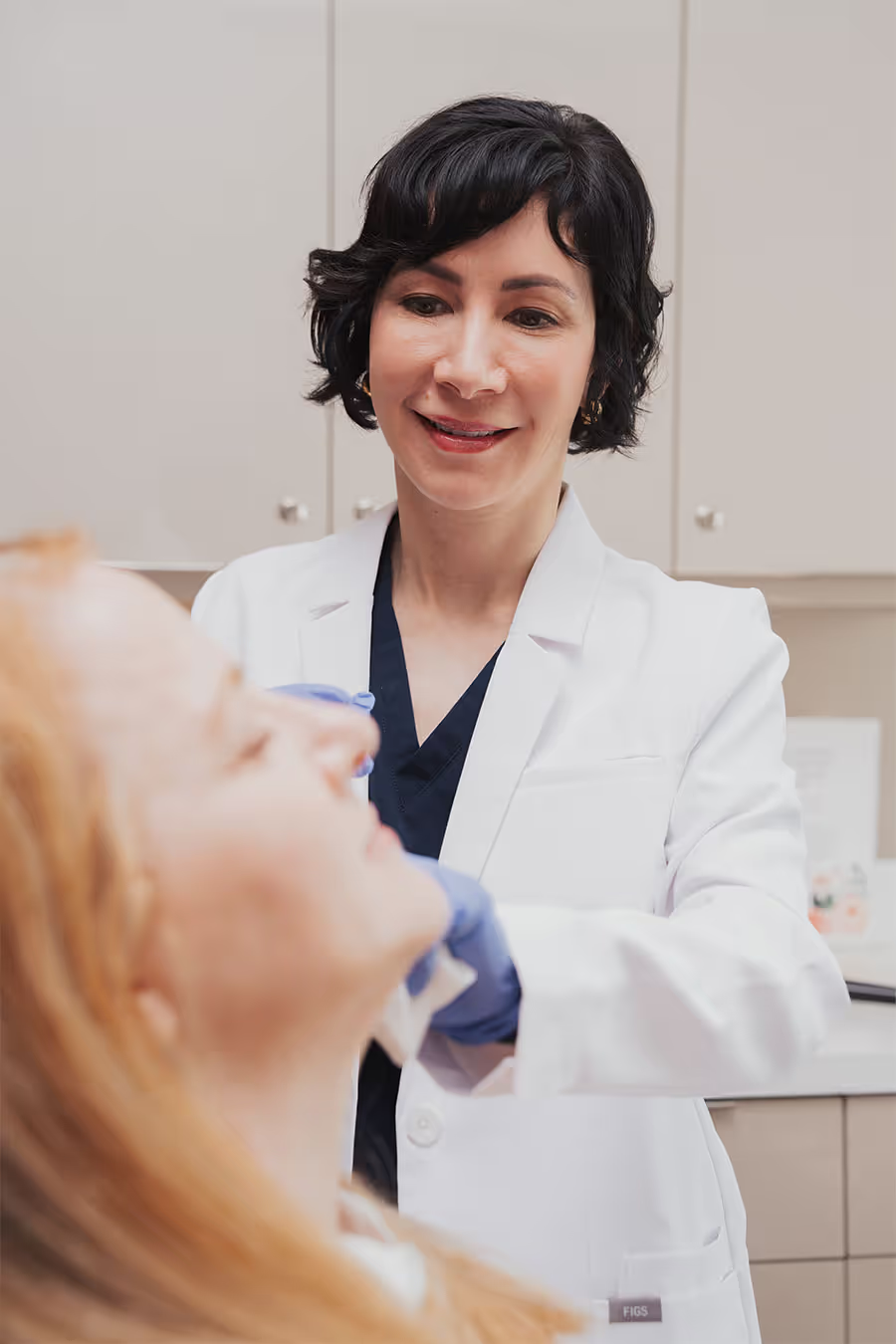
A consultation is where that gets sorted out. Your provider checks how each line behaves with expression and at rest, along with overall skin texture and volume, then builds a personalized treatment plan around whatever mix of causes is actually present.
If you are trying to figure out which of your lines are muscle-driven and which are structural, Laser Center of Marin can help you sort through the difference during a consultation. The clinic offers physician-supervised neuromodulator, filler, and resurfacing treatments in Corte Madera for Marin County and Bay Area patients.
Call (415) 945-9875 or schedule online at marinlaser.com/contact.