Fraxel and IPL (Intense Pulsed Light, often called a "photofacial") are two of the most-requested laser treatments in our Marin County clinic. They're sometimes pitched as alternatives, pick one, but the more accurate framing is that they treat different problems. The right question isn't "which is better?" but "which one fits what you're actually trying to fix?"
At Laser Center of Marin we've operated the largest laser clinic in the Bay Area since 2003, with both Fraxel DUAL and multiple IPL platforms (including BBL Hero) under one roof. We use both, sometimes in sequence, occasionally in the same patient, and we'll tell you straight which one fits your skin.
| Factor | Fraxel DUAL | IPL Photofacial |
|---|---|---|
| Energy type | Fractional laser (1550 nm + 1927 nm) | Broadband pulsed light (500-1200 nm) |
| Primary target | Skin texture, scars, deeper pigment, fine lines | Surface pigment, redness, sun damage, vascularity |
| Depth | Deep (dermis) | Superficial (epidermis) |
| Downtime | 3-7 days (visible "sandpaper" texture) | None to minimal (mild redness for hours) |
| Number of sessions | 3-5 sessions | 3-5 sessions |
| Time between sessions | 4 weeks | 3-4 weeks |
| Best for skin tone | Fitzpatrick I-IV, careful with darker tones | Fitzpatrick I-III, not for tanned skin |
| Pain level | Moderate (numbing required) | Mild (snapping sensation, no numbing) |
| Combinable with the other | Yes, often stacked across visits | Yes, often stacked across visits |
| Treats melasma | Yes (carefully, with 1927 nm) | Often makes it worse, avoid |
The shortest version: Fraxel rebuilds the skin from within. IPL clears the surface. They are complementary tools, not competing ones.
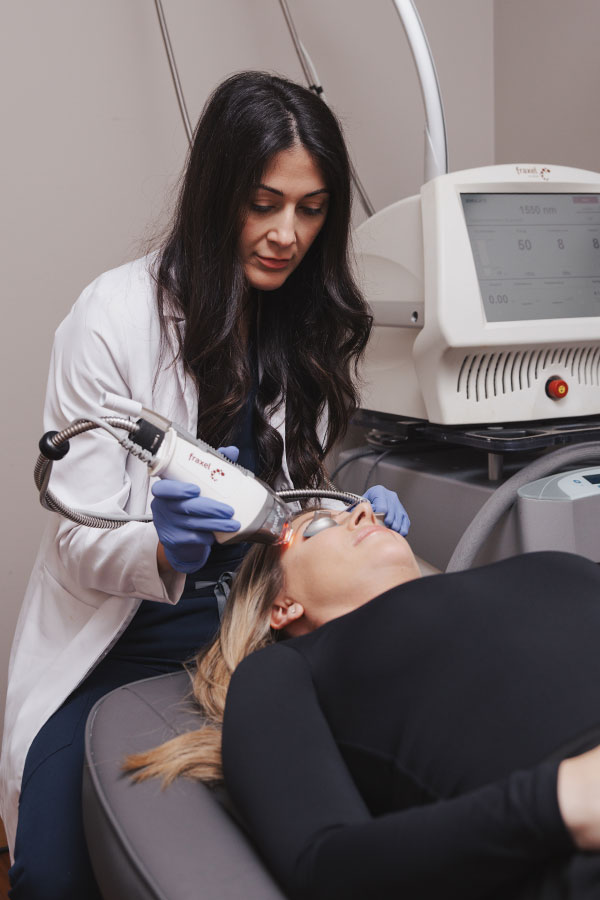
Fraxel is a fractional non-ablative laser. The word "fractional" is the key: the laser delivers energy in thousands of microscopic columns rather than treating the entire surface uniformly. Each column triggers a small wound-healing response deep in the dermis, while the untreated skin between columns supports rapid recovery.
Our Fraxel DUAL platform delivers two wavelengths:
The dual-wavelength flexibility is what makes Fraxel DUAL the workhorse it is. We can dial the laser to "deep texture day" or "pigment day" or split the visit and do both, customized to your skin's actual problem.
The dermal collagen response takes 2-6 months to fully express. Patients often see continued improvement long after the last session. Skin feels firmer, tone evens out, fine lines soften, and acne scarring shallows.
IPL is not technically a laser, it's a broadband pulsed light device. Instead of a single wavelength, IPL fires a range of wavelengths (typically 500-1200 nm) which selectively heat:
Because the energy targets the colored target, not the surrounding skin, the surface heals quickly. Brown spots often darken first (within hours), then flake off naturally over 7-14 days, leaving cleaner, more even skin behind. Redness from broken capillaries fades over weeks.
IPL works best on:
It does not meaningfully address skin texture, scars, or deep wrinkles. Anyone who tells you IPL "tightens skin" or "treats scars" is overselling. It treats color, not architecture.
This is the cleanest way to choose:
A common sequence in our clinic: 3 IPLs in spring to clear pigment, 2-3 Fraxels in fall/winter for texture (when sun avoidance is easier). It is the single most-requested annual maintenance plan among our long-tenured patients.
This is where the two diverge sharply.
Most patients schedule Fraxel on a Thursday or Friday for a discreet weekend.
IPL is a true "lunchtime" laser. Makeup the same day. Back to work immediately.
If you cannot tolerate any downtime, IPL is the answer. If you can plan a recovery week 2-3x per year, Fraxel delivers a result IPL cannot.
Both treatments require a series to deliver their full benefit. One-and-done is not how either of these tools work, and any clinic that promises otherwise is overselling.
Per-session cost in Marin County:
Packages and rewards through our membership program reduce per-session cost meaningfully. Both are eligible for Allergan Alle points where the product is in the Allergan ecosystem (some IPL platforms qualify, Fraxel does not, but the platform overall is on the Allergan-partnered Sciton family for BBL).
This matters and is often glossed over:
This is one of the most common reasons we recommend Fraxel over IPL for our darker-skin-tone patients, and one of the most common reasons we ask IPL patients to wait until winter or post-summer.
We frequently sequence the two for a single patient:
Phase 1, IPL series (3 sessions, 1 month apart): Clear surface pigment first. Brown spots and broken capillaries go first because they are the easiest "noise" to remove.
Phase 2, Fraxel series (3 sessions, 1 month apart): Now that pigment is cleared, address texture, scars, and fine lines without the laser energy being distracted by surface pigment.
Phase 3, Annual maintenance: 1-2 IPLs and 1 Fraxel per year, sequenced around sun exposure.
This is the protocol that has built our long-tenured Marin patient base since 2003. It is steady, layered, and the results compound over time.
We've operated the largest laser clinic in the Bay Area since 2003, and we have always believed that a clinic that owns only one laser is going to recommend that laser for every problem. We refuse to do that.
We own multiple IPL platforms (including BBL Hero), Fraxel DUAL, Laser Genesis, Halo-class fractional lasers, Ultherapy, Scarlet RF, and others, under continuous medical doctor supervision. The recommendation you get from us reflects your skin, your concern, your skin type, and your timeline. Not our inventory.
We will say "do IPL first" or "skip the IPL, go straight to Fraxel" depending on what your face shows us. That product-agnostic posture is the most valuable thing a multi-modal clinic offers.
BBL (BroadBand Light, Sciton) is an upgraded form of IPL with tighter wavelength control, a cooled sapphire tip, and stronger evidence for long-term skin health improvements. It belongs to the IPL family, but it's a meaningful step up. We offer both.
We generally recommend separating them by at least 2-4 weeks. The combined inflammation isn't worth the convenience, and the IPL is easier to dose accurately on un-treated skin.
Standard 1550 nm Fraxel can occasionally worsen melasma. Our 1927 nm Fraxel DUAL setting is specifically designed for melasma and is one of the safer laser approaches when paired with a proper pre/post topical regimen. We discuss this case-by-case.
Fraxel, unambiguously. IPL does not meaningfully address scars. For deeper scars we often combine Fraxel with microneedling RF (Scarlet) across a series.
IPL, visible improvement within 1-2 weeks of each session. Fraxel, initial glow at 2 weeks; full collagen response peaks at 3-6 months.
Both require strict sun protection during and after. Marin's mild climate makes year-round treatment possible, but we cluster Fraxel into fall and winter for most patients to make sun avoidance easier.
We have been caring for Marin County and the Bay Area since 2003. Book a consultation or call us at (415) 945-9314.