If the idea of lip filler has felt like a big, permanent decision, you are not alone in thinking that. Most patients booking their first lip consultation believe they are committing to something. Once the product is in, they will live with the result until it wears off on its own timeline. That assumption is accurate for some filler materials. It is not accurate for hyaluronic acid. The same enzyme the body produces to break down native HA can dissolve a lip filler in days.
This is not a rescue option. It is a property built into the molecule at the chemical level. That is one of the primary reasons HA became the standard of care for lip treatment. In 2023, 1,439,291 lip augmentation procedures with injectable materials were performed by American Society of Plastic Surgeons members, a 4 percent increase from 2022.
Hyaluronic acid is a glycosaminoglycan, a type of carbohydrate molecule present naturally in human skin, connective tissue, and synovial fluid. In the skin, HA sits within the structural framework of the skin, where it plays a primary role in maintaining tissue structure and hydration.
The molecule is highly water-attracting: it attracts and retains water within the tissue where it is present. This is why HA-rich skin appears plump. The gradual reduction of native HA that comes with age contributes to the thinning and flattening visible in the lips over time.
Native HA in the body degrades continuously.
Hyaluronidase, an enzyme produced throughout the body, breaks the HA polymer chain down at a constant rate. Without chemical modification, injected HA would clear from the tissue within days. Cross-linking is what changes that.
Cross-linking transforms HA from a fast-degrading molecule into a filler with a six- to 12-month functional lifespan. The cross-linking agent used in the Juvederm product family is BDDE (1,4-butanediol diglycidyl ether). BDDE creates chemical bonds between HA polymer chains, forming a three-dimensional gel network. This network resists the enzymatic breakdown that would otherwise clear the product within days.
The degree of cross-linking in a product controls two properties simultaneously: how stiff the gel is and how long it lasts. Higher cross-link density produces a firmer, more durable gel. Lower cross-link density produces a softer gel with somewhat shorter duration. Manufacturers engineer these values by product line, which is why different Juvederm formulations behave differently across different anatomical zones.
The lips move constantly. Eating, speaking, and expression place mechanical demand on the tissue and whatever is placed inside it. A material that is too stiff creates an unnatural feel and resists normal lip movement. The lip-specific formulations in the Juvederm family are engineered toward the softer end of the stiffness range. They flex with the tissue rather than against it.
G-prime, a gel's measure of elastic stiffness, determines which product is appropriate for which sub-zone within the lip. A product with a higher G-prime placed along the vermilion border holds definition against the mechanical forces of movement and expression.
A lower-G-prime product placed within the body of the lip distributes evenly and produces a soft, natural result that moves with the face. Placing a single product uniformly across the entire lip ignores this distinction and produces a less nuanced result.
HA gel also integrates with the surrounding tissue over the four weeks following injection. It absorbs water from the tissue environment, softens slightly, and becomes less distinguishable from the surrounding structure. The result at four weeks is a truer representation of what the patient will live with. The immediate post-appointment result reflects swelling that has not yet resolved.
Hyaluronidase dissolves cross-linked HA filler when injected into the treated area. The enzyme disrupts the gel network, and the product clears from tissue over 24 to 48 hours. Full tissue settling takes one to two weeks.
For most patients, learning this is the moment the hesitation lifts. No other widely used filler material has an equivalent reversal mechanism. Sculptra and Radiesse are not enzyme-reversible. Permanent and semi-permanent options have no clinical dissolving pathway at all.
The practical argument for HA as the standard of care for lips is not that it is the most durable option. It is the most controllable option in a zone visible in every photograph, every conversation, and every expression across the months it is present.
As the face changes with age or when placement needs modification, hyaluronidase makes adjustments available. It is a routine clinical step, not a last resort.
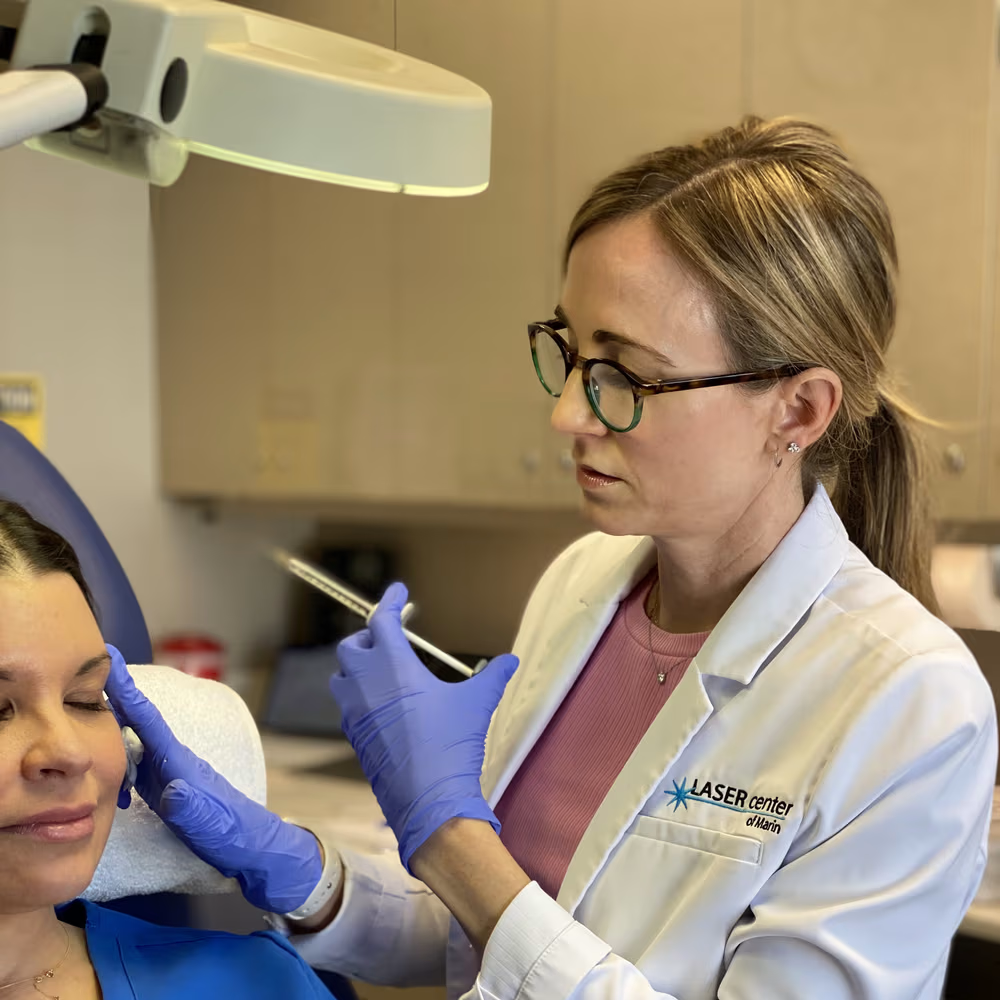
A lip filler appointment at The Laser Center of Marin begins with a consultation reviewing your specific lip anatomy, your goals, and the product selection appropriate for your structure. The volume placed is not standard across patients. It is built from your starting vermilion shape, your vertical lip height, and the result you want to achieve.
Topical numbing cream is applied for 10 to 15 minutes before injections begin. The gel contains lidocaine, which provides additional anesthesia that builds as placement continues. Most patients describe pressure and mild stinging rather than sharp pain. The appointment runs 30 to 45 minutes from consultation through aftercare review.
Swelling peaks in the first 24 to 48 hours and resolves over one to two weeks. The integrated result is visible at four weeks. Most patients schedule maintenance at six to 12 months, depending on the product and their individual metabolism.
For patients who want a fuller upper lip without added volume, the lip flip relaxes the upper lip border with a small amount of Botox.
Certain conditions require modification or postponement of treatment before proceeding.
Active cold sore or history of oral herpes simplex (HSV-1). Injection at or near the lip can reactivate latent herpes simplex in patients with a prior history. Preventive antiviral medication, starting one to two days before the appointment, reduces this risk. This protocol is discussed and arranged at the consultation, not on the day of the appointment.
Blood thinners or anticoagulants. These increase bruising at injection sites. Whether to pause them requires a review with the prescribing provider. Your provider will document that review at the consultation.
Known allergy to hyaluronic acid, lidocaine, or bacterial proteins used in filler manufacturing. HA fillers are manufactured using bacterial fermentation and contain lidocaine. A documented allergy to any of these components is a contraindication to treatment.
Active infection or inflammatory lesion at the lip. Treatment in the presence of an active cold sore, infection, or open lesion is rescheduled to a fully cleared baseline. Injecting into an active infection risks spreading bacteria through the injection sites.
Pregnancy or breastfeeding. Elective injectable treatments are paused during these windows.
The first 24 to 48 hours after lip filler placement are when the product is most susceptible to displacement from external mechanical force.
The most common concern in the first week is swelling, and it is worth knowing in advance, so it does not alarm you. Swelling can make the lips appear larger than they will be in the final result.
At The Laser Center of Marin, an Allergan Black Diamond and top-100 U.S. practice serving Marin County since 2003, our nurse practitioners treat reversibility as a design criterion in every lip filler plan.
Meghan Dasher, Lisa Leung, RN, MS, NP, and Kimberly Hanf, NP-C, build each plan from that premise. The ability to dissolve, adjust, and reassess is not unusual. It is a routine part of long-term lip treatment planning.
The molecule is structurally similar but functionally different. Topical HA serums apply a non-cross-linked form to the skin surface, where it supports surface moisture retention. Injectable HA filler is cross-linked into a stable gel that provides structural volume within the tissue. The two forms serve different purposes and do not interact.
The immediate post-treatment result reflects the placed product plus the tissue's acute swelling response to injection. Over four weeks, swelling resolves, lidocaine clears, and the gel softens through tissue integration. The four-week result is more pliable, more natural-feeling, and more representative of the long-term outcome.
Most HA lip fillers last six to 12 months. The high mechanical activity of the lips accelerates the natural degradation of the cross-linked gel compared to less mobile facial zones. Individual metabolism also affects duration.
Yes, with the appropriate precautions. Patients with a prior history of oral herpes simplex require preventive antiviral medication before the appointment. Discussing this history at the consultation allows the prescribing protocol to be arranged in advance.
This is one of the most common questions at a first consultation, and the answer is reassuring. Hyaluronidase dissolves HA filler in the office. The process takes effect within 24 to 48 hours, with full tissue settling over one to two weeks. Discussing this option at the consultation is standard practice, not a signal that the result will need it.
If you have been sitting on the fence about lip filler, a consultation is the right place to bring your questions. It is how you evaluate whether this is the right treatment, the right time, and the right plan for your lips.
The Laser Center of Marin is a physician-supervised Allergan Black Diamond and top-100 U.S. practice with over two decades of experience serving Marin County patients with personalized injectable care. Explore our full range of options on our dermal filler page.
Visit us at 770 Tamalpais Drive, Suite 301, Corte Madera, CA 94925, book online, or call (415) 945-9314 to book your consultation.
Medical Disclaimer: Consultation required. Individual results may vary based on lip anatomy, product selected, volume placed, and individual metabolism. Patients with a history of oral herpes simplex require an antiviral prophylaxis discussion before treatment. Full allergy and medication history must be disclosed before any injectable procedure.