Most patients with acne scars have already tried everything available at the surface. They have used brightening serums, chemical exfoliants, and professional peels, yet they are frustrated that the scars remain. That frustration makes sense. The scars persist because the problem is not a surface problem.
Acne scars are structural changes in the dermis, the deeper layer of skin where collagen is produced and maintained. Reaching that layer requires a different approach than any topical can provide.
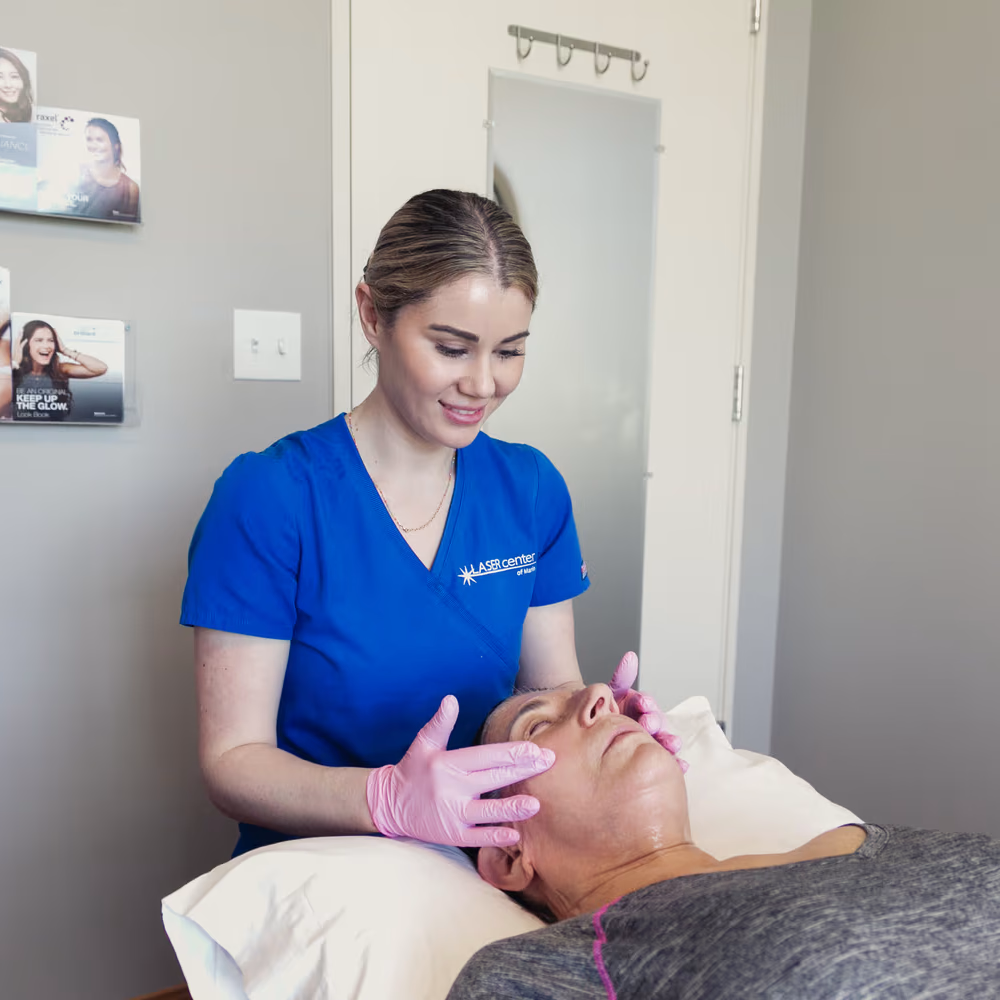
The Laser Center of Marin offers the Micropen Elite microneedling system as part of our physician-supervised treatment program serving Marin County patients. Our providers perform every Micropen session and assess each patient's scar pattern and skin type before recommending a series.
Acne scars form when a breakout damages the dermis and the body's repair process produces irregular collagen rather than restoring the original tissue structure.
When a severe or inflamed pimple ruptures, it damages tissue in the dermis. The body responds by sending fibroblasts to rebuild the damaged area. In many cases, the repair produces an uneven distribution of new collagen, resulting in one of several scar types.
Rolling scars are broad, wave-like depressions caused by fibrous attachments pulling the skin surface downward. Boxcar scars are wider, flat-bottomed depressions with defined vertical walls, caused by localized collagen volume loss. Ice pick scars are narrow, deep channels that form when an infected follicle destroys a thin column of tissue straight down into the dermis.
Topical products work at or just below the surface and into the upper epidermis. None of them reaches the dermal layer where scar tissue lives. This is why surface-only approaches do not change scar depth.
The Micropen Elite creates controlled micro-channels in the dermis that trigger the body's wound-healing response, which stimulates organized new collagen production in the scarred zone.
The device uses a sterile, disposable tip containing fine needles that oscillate at high speed across the treatment surface. The tip creates thousands of micro-channels per pass, penetrating to a depth determined by the provider, typically between 0.5 and 2.5 millimeters, depending on scar depth and skin zone.
These channels trigger the wound-healing cascade, a three-phase repair sequence of inflammation, tissue rebuilding, and remodeling. In the remodeling phase, fibroblasts are recruited to the treated area. They produce new, organized collagen to fill in the micro-channel pathways. Over multiple sessions, this new collagen builds progressively in the scar depressions. The structural floor of the scar rises as new collagen fills the void from below.
A 2018 study by El-Domyati, Abdel-Wahab, and Hossam, published in the Journal of Cosmetic Dermatology, confirmed histologically that microneedling produces measurably increased epidermal thickness, more organized collagen bundles, and newly formed collagen in the treated dermis across a series of sessions.
Rolling and boxcar scars respond best to microneedling. Ice pick scars are more difficult and typically require additional or alternative treatment approaches.
Rolling scars improve substantially with serial microneedling because the mechanism directly addresses the fibrous tissue bands pulling the surface downward. As collagen builds in the dermis, the downward tethering gradually relaxes.
Boxcar scars improve with microneedling but benefit from combination approaches, such as applying platelet-rich plasma or a targeted serum during the micro-channel window of treatment.
Ice pick scars are the pattern patients most often come in worried about, and it is worth being honest about what microneedling can and cannot do for them. Because of their depth and narrow diameter, they respond less predictably to standard microneedling alone. A combination approach or an alternative treatment is often more effective for this pattern, and we discuss that at the consultation.
Post-inflammatory hyperpigmentation responds well to the Micropen series because the improved surface turnover and new collagen production support a more even tone over time. The acne scarring concern page and the acne concern page explain how we distinguish the two.
The standard protocol for acne scar treatment is three to six sessions, each spaced four to six weeks apart.
The collagen remodeling timeline sets this interval. Collagen production begins immediately after each session but takes four to six weeks to mature. Spacing sessions within this window allows the skin to complete one round of repair before the next stimulation begins.
Sessions run 30 to 60 minutes, depending on the treatment area. A topical numbing cream is applied 30 to 45 minutes before the Micropen begins. Most patients describe the sensation as a mild vibrating pressure with some warmth.
Results build across the series, and the timeline asks for genuine patience. Visible improvement typically begins four to six weeks after the first session. The full extent of collagen remodeling becomes visible three to six months after the final session, which is longer than most patients expect but reflects how deep collagen maturation actually works. The deepest layers of new collagen complete maturation in that window.
Certain conditions require delaying or ruling out Micropen treatment.
Active acne lesions. Microneedling over active pustules or papules risks spreading bacteria through the micro-channels into adjacent tissue. Treatment is scheduled only when the skin is in a stable, non-inflamed phase.
Oral isotretinoin (Accutane). Oral isotretinoin fundamentally alters skin cell turnover and sebum production, making the wound-healing response after microneedling unpredictable. Treatment requires a pause of typically six to twelve months after the last isotretinoin dose.
Keloid tendency. Patients with a history of keloid or hypertrophic scarring are at higher risk of an abnormal wound-healing response from microneedling. A provider consultation is required before treatment.
Blood thinners or anticoagulants. These medications increase bleeding at the micro-channel sites and alter the wound-healing response. Whether to pause these medications requires review with the prescribing provider.
Active skin infection, eczema, or psoriasis in the treatment area. A compromised skin barrier increases infection risk. Treatment is rescheduled once the skin returns to a stable baseline.
Pregnancy. Elective procedures that induce a wound-healing response are paused during pregnancy.
The 24 to 72 hours following a Micropen session are the most important window for aftercare, because the micro-channels are briefly open and the skin is in an active healing state.
Most patients see meaningful improvement with three to six sessions. The number depends on scar depth, pattern, skin type, and how the skin responds after the first session.
Microneedling produces visible improvement in scar depth and texture across a series. Complete elimination is not a realistic expectation, but many patients achieve 40 to 70 percent improvement in overall scar appearance. For skin that has carried visible scarring for years, that is significant.
Yes. Microneedling is frequently combined with platelet-rich plasma applied during the session while micro-channels are open. It can also be incorporated into a broader treatment plan alongside fractional laser resurfacing or chemical peels.
Yes. Unlike laser-based scar treatments, microneedling does not rely on melanin as a chromophore. The device creates mechanical channels without heat or light-based targeting. Microneedling is broadly appropriate across all Fitzpatrick skin types with appropriate aftercare.
The skin must be fully cleared of active inflammatory lesions before beginning a series. For patients finishing oral antibiotics for acne, a pause of at least two to four weeks after clearing is typical. For patients finishing oral isotretinoin, a minimum pause of six to twelve months before microneedling is standard.
If you have been carrying acne scars for years and are not sure where to start, a consultation is exactly the right first step. Acne scars respond to a consistent, sequenced treatment plan, not a single session. The right approach depends on scar pattern, skin type, and what combination of treatments makes sense for your specific history.
The Laser Center of Marin has served Marin County as a physician-supervised med spa since 2003.
Explore our full treatment menu for additional options. Visit us at 770 Tamalpais Drive, Suite 301, Corte Madera, CA 94925, or call (415) 945-9314 to schedule your consultation.
Medical Disclaimer: Consultation required. Individual results may vary based on scar type, depth, Fitzpatrick classification, and number of sessions completed. Micropen treatment is contraindicated during active acne flares, within six to twelve months of oral isotretinoin, and for patients with a keloid or hypertrophic scarring history. All medications must be disclosed at consultation.


