The routine that cleared your friend's skin may be actively worsening yours. This is not a product quality problem. It is the predictable result of applying a protocol built around one person's biology to a different set of skin conditions.
Ingredients that make a retinol or niacinamide routine effective for one skin type can drive congestion, barrier breakdown, or post-inflammatory hyperpigmentation (dark marks left after inflammation or acne heals) in another. The mechanism is biology. The solution is a customized skincare regimen that starts with your skin, not someone else's.
The Laser Center of Marin has provided physician-supervised skincare consultations and treatments to Marin County patients since 2003. Our provider team builds every skincare plan from a clinical skin assessment, not from a product catalog or trending ingredient list.
It is not that influencer routines are built on bad products. They are often built on genuinely effective ones. The problem is that they are built on one person's biology, and skin type, skin tone, sebum production, and barrier integrity vary significantly between individuals in ways that change which ingredients are beneficial versus harmful.
The Fitzpatrick scale, which runs from type I to type VI, determines how skin responds to UV exposure, active ingredients, and professional procedures. A brightening acid concentration appropriate for Fitzpatrick type II skin can trigger post-inflammatory hyperpigmentation in Fitzpatrick type IV or V. The same widely recommended formula serves both audiences differently.
Sebum production is largely genetic and determines whether a skin type is oily, dry, combination, or sensitive. An alcohol-heavy toner that controls excess sebum in a genuinely oily skin type strips the lipid barrier (the fatty layer that seals in moisture) in a dry skin type. The result is paradoxical: the barrier breaks down, oil production increases as a compensatory response, and the skin becomes simultaneously oily and dehydrated.
Transepidermal water loss, or TEWL, the rate at which moisture escapes through the skin surface, varies significantly between individuals. Patients with naturally elevated TEWL, often those with compromised barrier function, dehydrate faster under active ingredient loads than an average-barrier skin type does without difficulty.
According to the American Academy of Dermatology, acne is the most common skin condition in the United States, affecting up to 50 million Americans annually. A significant proportion of treatment-resistant cases involve the wrong products being applied in response to the condition.
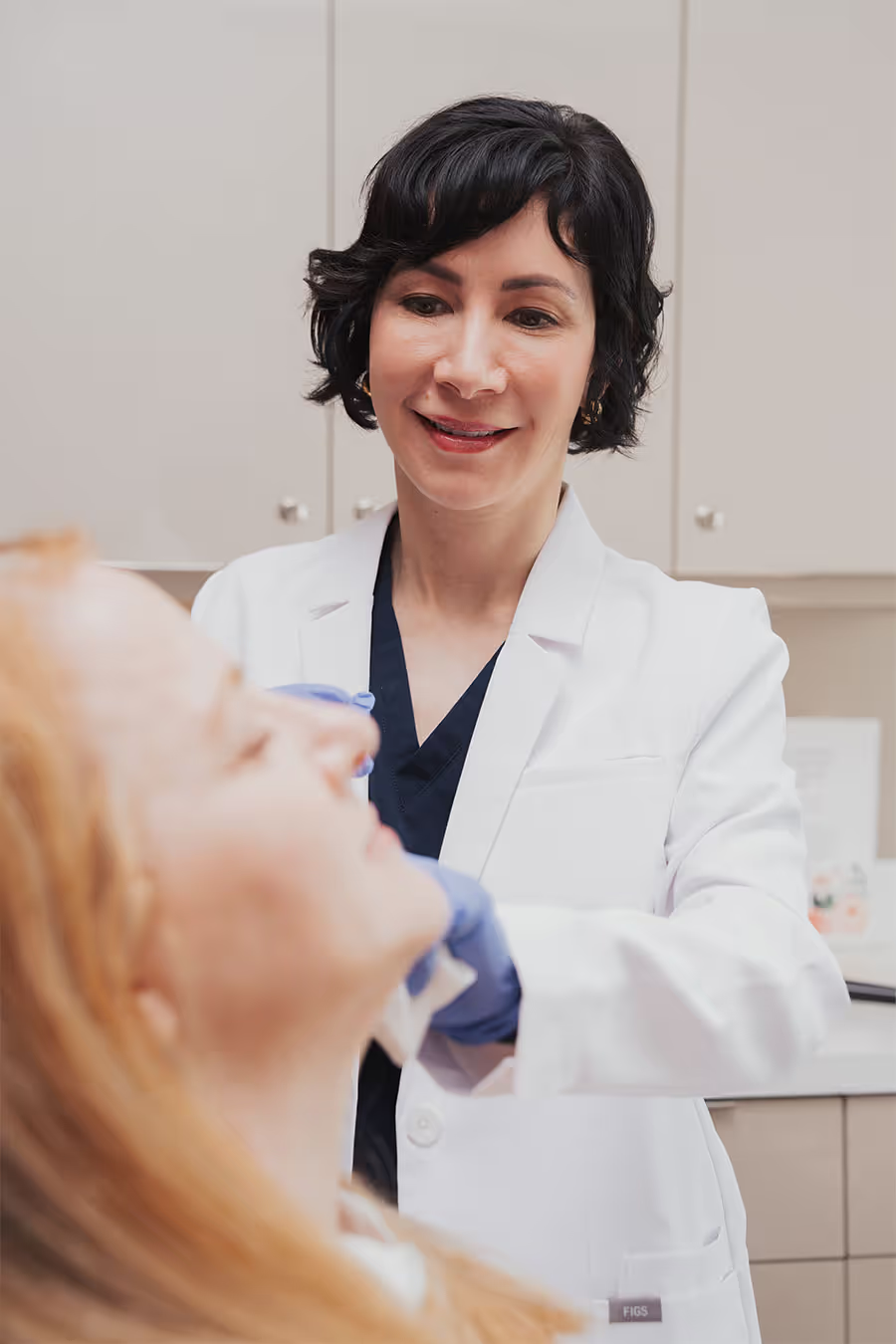
A personalized skincare consultation at Laser Center of Marin begins with a clinical skin assessment, not a survey of what the patient currently uses.
Our provider team evaluates skin type, sebum activity, barrier integrity, Fitzpatrick classification, and the primary concerns driving the patient to seek care. Next, they review the patient's current product routine to identify what is contributing to those concerns, what is neutral, and what is producing unintended effects.
The assessment identifies four things that no online quiz or influencer routine addresses:
From that assessment, our providers build a customized skincare regimen with a specific morning routine, an evening routine, and a protocol for introducing actives at a rate the barrier can tolerate. An in-office treatment program is added if professional work is appropriate.
The order in which active ingredients are applied determines whether they work at the correct depth or neutralize each other before reaching the target layer.
Vitamin C inactivates retinoids when both are applied at the same time in the same routine. Both are beneficial individually. Applied together, they compete chemically and degrade faster.
Exfoliating acids (glycolic, lactic, and salicylic) applied in the wrong concentration for barrier thickness produce barrier disruption rather than controlled exfoliation on sensitive skin types.
Ceramides, the fats that hold the skin barrier together, form the repair foundation that makes active ingredient use sustainable over time. Without adequate ceramide replenishment, an active-heavy routine progressively thins the barrier and increases sensitivity.
A personalized plan sequences these ingredients specifically for the patient's barrier tolerance and rebuilding timeline.
In-office treatments address concerns that topicals cannot reach, but results are best when the barrier is stable enough to support a controlled healing response.
Surface-level treatments like DiamondGlow and dermaplaning optimize topical penetration and skin clarity for patients whose primary concern is texture, congestion, or dullness. Clear + Brilliant laser addresses early photodamage and uneven tone. Each treatment works best when the at-home routine has established a stable baseline.
Our providers design the at-home and in-office components of the plan together. The at-home routine prepares the skin for in-office work and extends the results between sessions. Neither element works as well in isolation.
If your routine is not working, the most common reason is not the products themselves. It is starting activities on a compromised barrier or introducing too many new products at once, before the skin has had time to respond to any single change.
Starting a new retinoid, exfoliating acid, or vitamin C on skin that is already sensitized, over-stripped, or reactive amplifies the damage rather than the benefit. The standard clinical protocol is to repair the barrier first, using ceramide-rich moisturizers and fragrance-free cleansers, before introducing any active.
Patients using oral isotretinoin (Accutane), topical tretinoin, or high-dose prescription topicals should not layer over-the-counter actives without provider review. The prescription strength already represents a significant active load.
Pregnancy and breastfeeding require significant modification to any active skincare routine. Retinoids are contraindicated. High-concentration salicylic acid is contraindicated. A provider review of the full routine is appropriate for any patient who becomes pregnant while using active skincare.
A personalized skincare plan requires ongoing reassessment because skin conditions change seasonally, with hormonal cycles, and with age.
The plan built at the initial consultation is reviewed at follow-up. What was appropriate for initial barrier repair may need modification once the barrier is stable. What works in summer humidity may not work in dry winter conditions. As skin ages, sebum production, cell turnover rate, and the skin's natural ceramide production all change.
A skincare review one to two times per year is the maintenance protocol for most patients. For those undergoing active in-office treatment programs, the at-home routine is reviewed more frequently.
If your skin feels tight after cleansing, reacts to products it used to tolerate, flakes without responding to moisturizer, or breaks out in areas that are not typical for your skin type, these are signs the barrier may be compromised rather than signs you need stronger products. Our providers assess barrier integrity at a consultation and recommend a repair protocol if needed.
A skincare consultation starts with your overall skin picture rather than a predetermined procedure. It results in a plan. A treatment appointment delivers a specific procedure. Many patients benefit from a consultation before choosing a treatment to confirm that the treatment addresses the right concern.
Yes, in most cases. The consultation determines which existing products are compatible with DiamondGlow and which need modification around each treatment session. Certain activities need to be paused for the 24 to 48 hours surrounding each session.
Product-induced acne, sometimes called comedogenic reactions, tends to appear in areas not typical for hormonal breakouts and develops on a timeline that corresponds to introducing a new product. A consultation can often identify the pattern. See our acne concern page for additional context.
The clinical assessment at Laser Center of Marin includes Fitzpatrick evaluation, barrier assessment, and treatment planning with in-office options available. A spa facial does not involve that level of assessment. If you have a condition, sensitivity, or prescription medication that affects what your skin can tolerate, that distinction matters.
If your skin is not responding to your current routine, the routine may not be wrong. The routine may simply have been designed for a different skin. The Laser Center of Marin has served Marin County as a physician-supervised med spa since 2003. Our full provider team builds personalized plans from clinical assessment, not from trending ingredients. Explore our full treatment menu for additional options.
Visit us at 770 Tamalpais Drive, Suite 301, Corte Madera, CA 94925, or call (415) 945-9314 to schedule your consultation.
Medical Disclaimer: Consultation required. Skincare recommendations are individualized based on clinical assessment. Active ingredient protocols for patients on prescription topicals, oral isotretinoin, or during pregnancy require provider review before modification. Individual results vary based on skin type, baseline barrier condition, and adherence to the recommended plan.